
From Mancala to Solitaire
The Marajoara designer’s diary
by Daniel Lucca
Hello! For those of you who don’t know me, I’m Daniel de Lucca, the author of the game Marajoara. I was invited by the Glyptodon Studio team to write a brief diary about the creation of this title. The game is about to be released, but its story began a few years ago.
I still remember the day I played Trajan for the first time. The idea of using an old game (Mancala) to serve as a selection of action mechanics, as a minigame within the game, really caught my attention. I’ve always been fascinated by creative ideas. And there, playing Trajan, was one of the moments in a board game that I was fascinated by the idea.
Some time passed and I saw a random scene on TV, of people playing Solitaire with beans. Then I remembered what Stefan Feld did with Trajan and I questioned: “ Why have they never used the Solitaire mechanic in a modern board game?”. Six months, a Spiel Digital and a prototype later, I had a closed contract! My first contract as a game designer. But I had a “problem”: Diego Bianchini, CEO of MeepleBR, loved the mechanic, but didn’t like the game.
In that version, the game was too inflated and unbalanced. No wonder, I participated in the Spiel Digital in a frenzy, testing the game very little. In addition, the way it was would be expensive to produce and aimed at a more expert audience.
Upon signing the contract, one condition was agreed: to make that game something more family-oriented, more elegant. The premise was to keep the original game mechanic for action selection.
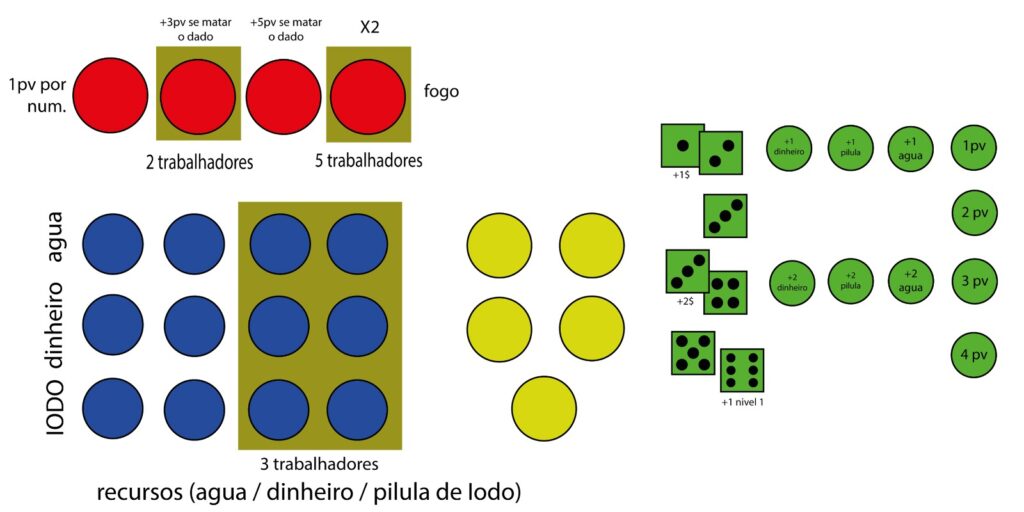
THE SOLITAIRE
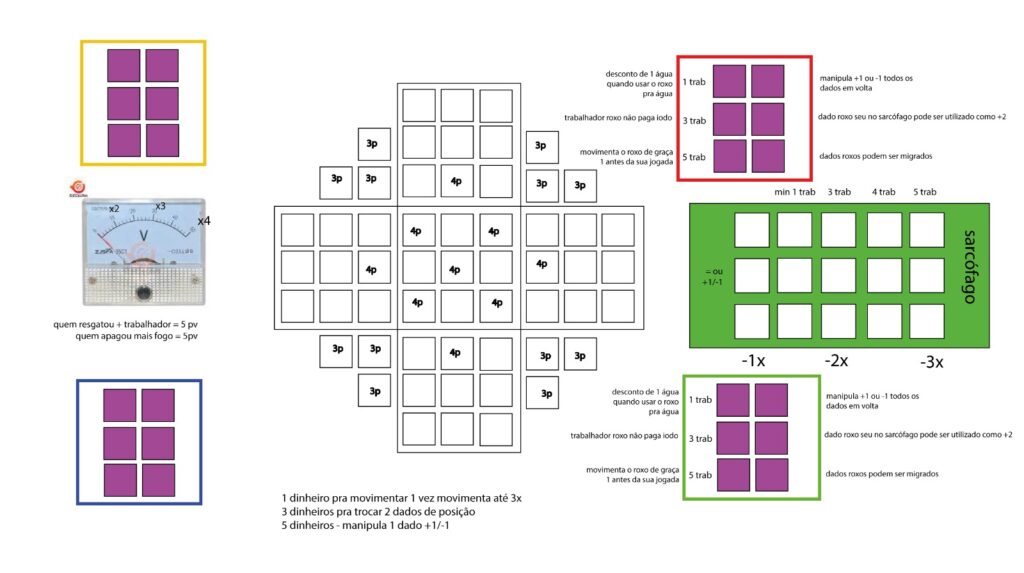
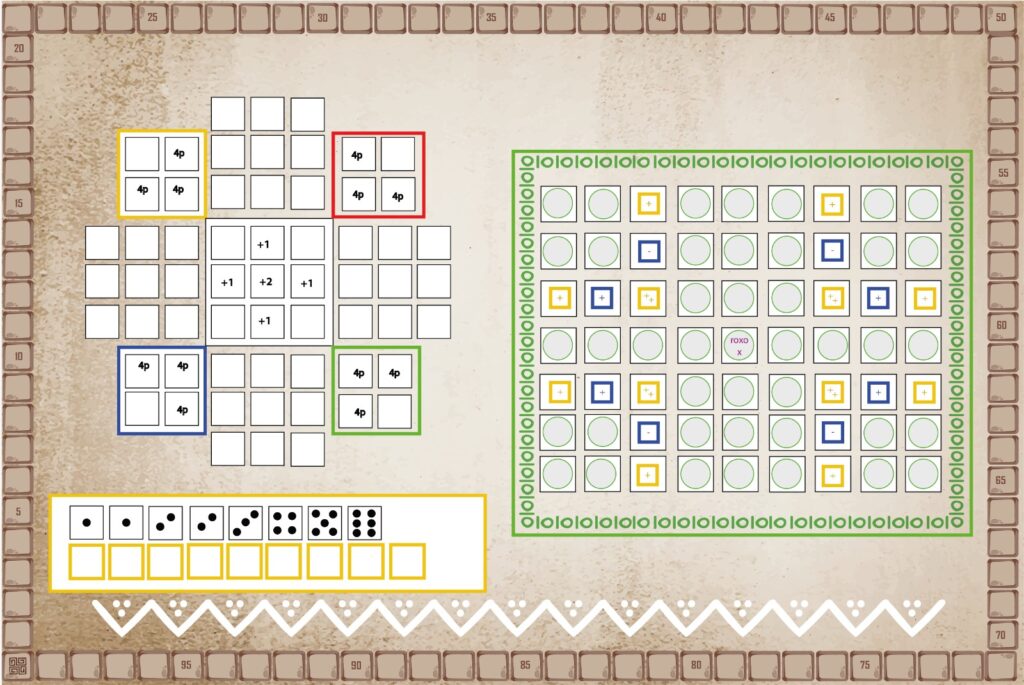
Before continuing, let’s talk a little about what was done with the Solitaire. We used a board similar to the famous game with dice facing the 1 face instead of the standard pieces.
When using a die to jump over another, the one that jumped increases one number and the one that was jumped over is captured by the player. According to the color of the die, the player can perform the action at a strength equal to the captured die.
This idea of using dice brought a natural evolution to the game, as the player is left with increasingly larger dice to execute the actions.
Another novelty is: instead of there being a Solitaire for each player, this game should have a shared Solitaire, completely transforming the game mechanic.
If before it was a game about a kind of “tableau building” with dice, in which you planned to leave increasingly larger dice to do future actions, now it has become a game about blocking, in which leaving larger dice was no longer good, but rather, bad.
To make this dispute even “spicier”, I added the “research chips” that block certain spaces, because, if an enemy falls on your chip, you can increase one of your dice by two.
This main mechanic was so self-sufficient that all the complications related to the secondary mechanics (what to do after you pick up the die?), took away a little of the shine of the competition for larger dice, which was the main difference of the game.
A NEW VERSION EMERGES
After many versions and changes, we thinned out the secondary mechanics as much as possible, leaving each die color with similar importances and straight to the point.
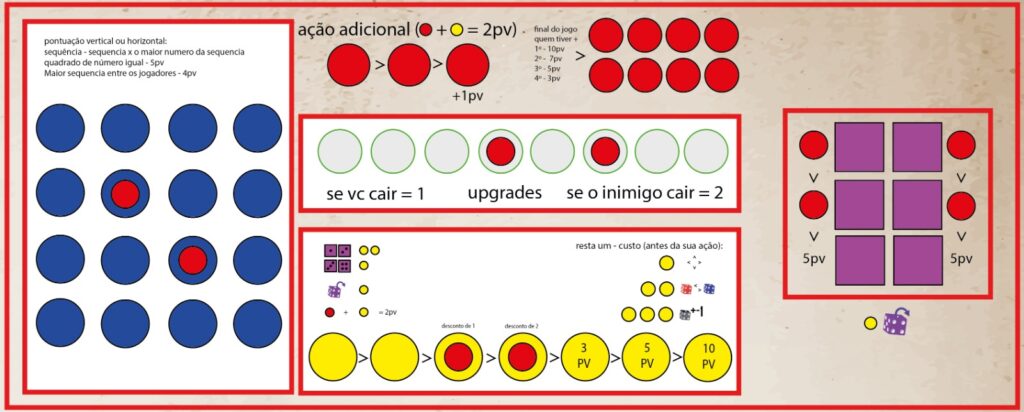
With this, two main scoring methods emerged: 1st spend combinations of blue dice as resources to fulfill direct contracts; and, 2nd contracts with red and yellow dice. While the combined blue dice should provide points according to the combinations, the “red contracts” were open scoring and just had to combine a red and a yellow die of the same number to score.
The yellow die, besides serving to fulfill the red contracts, it became the currency of the game, and with that the player can use it to manipulate dice in the Solitaire and increase the value of the blue dice.
Finally, the brown die turned into a support for these two ways of scoring, making it advance on the three tracks that increased the value of the dice, bringing special abilities and more ways to score, always linked to the other colors of dice.
This mechanical simplicity brought the players’ attention directly to the competition for dice in Solitaire, bringing an interesting strategic depth, without diverting more attention than it should to the secondary mechanics.
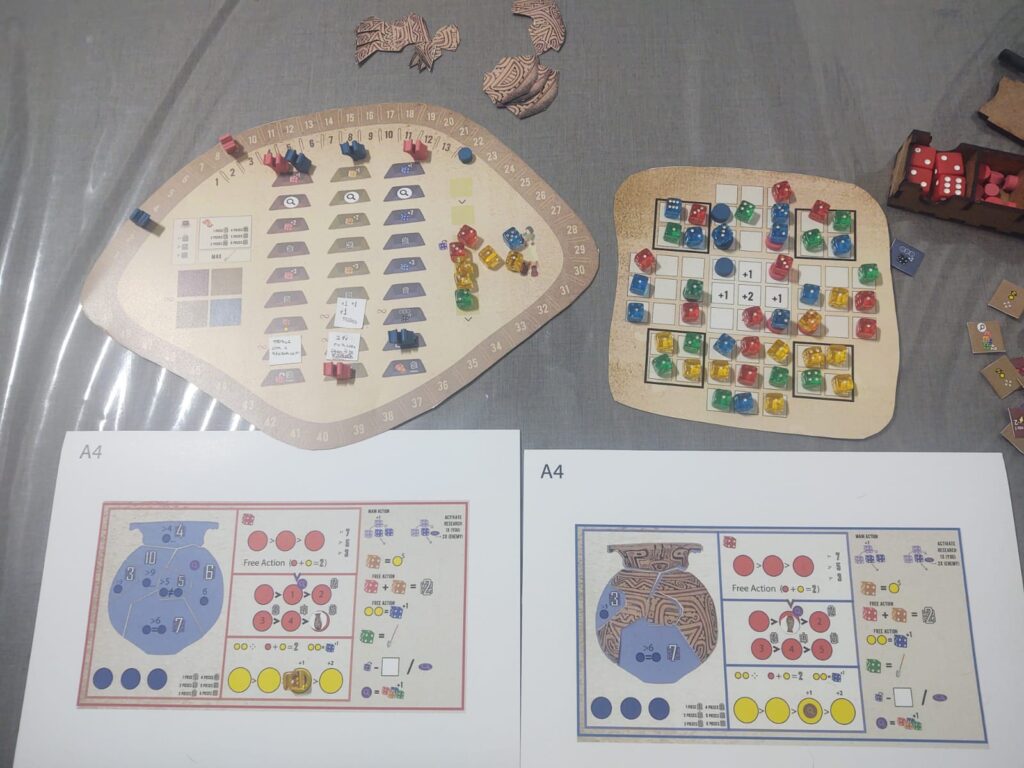
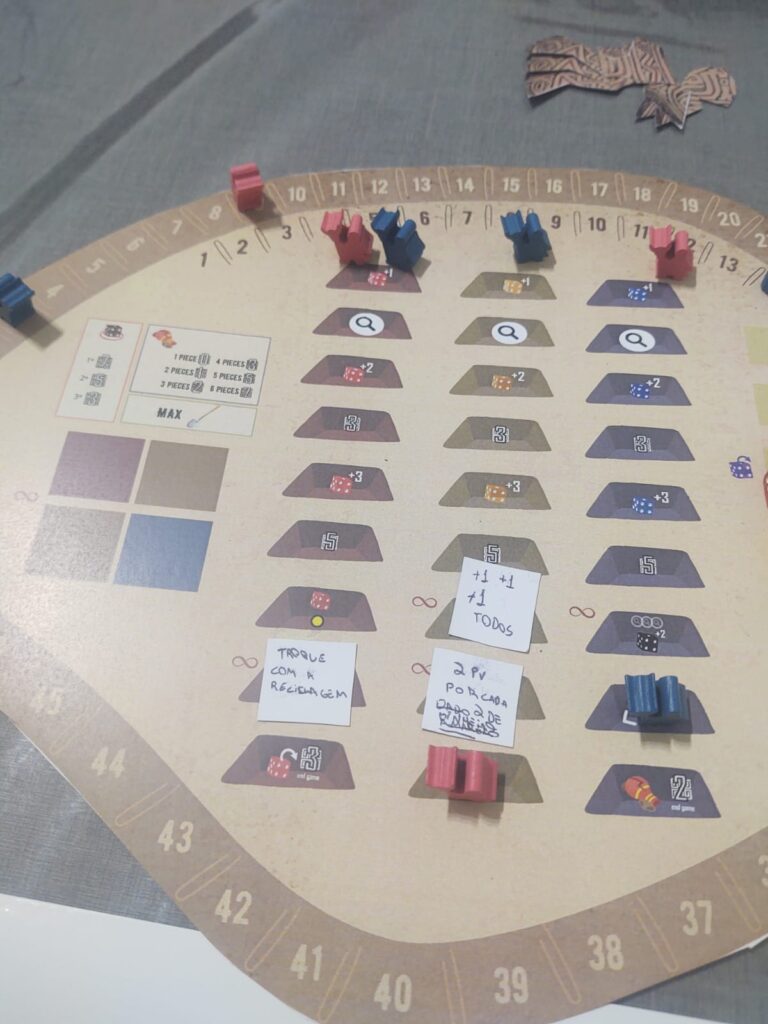
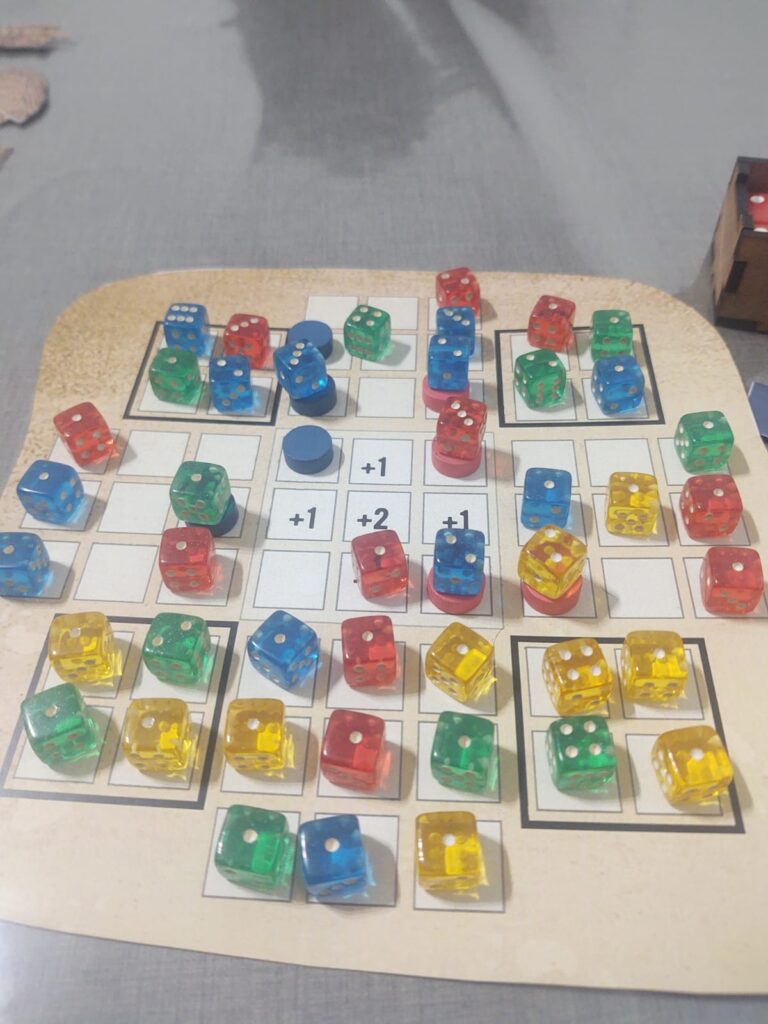
Physical prototype of Marajoara, with all the mechanics already defined.
A “PROBLEM” TO BE CORRECTED
The game was running smoothly and closer to what we wanted with it, however, there was still a “problem” to be corrected. In Solitaire, as the rounds go by, the board becomes empty of possibilities, once the dice are gone.
Therefore, it was necessary to find a way to add new dice to the board. Previously, there were blocked dice for each player, which they paid to unlock and earn a bonus for. However, this was not attractive enough to guarantee that players would fill the board with more dice, after all, placing more dice meant giving more opportunities to their opponents.
In addition, the game had many dice in the setup and an additional eight dice for each player to unlock during the game, which was adding up to almost 100 dice in the game. It was by trying to solve this impasse that the mechanic emerged, which I consider to be the second main mechanic of the game.
Instead of releasing dice by giving optional bonuses, I developed a dice recycling system, where the dice used to score go to recycling and eventually release dice that were already there, making players have to put the previously spent dice back on the board. With this, we reduced 32 dice from production and transformed what would be a “bonus” into something that must be done.
For example: when fulfilling a contract, I will release a six-sided die that my opponent wants and there is no way to leave it in a place where he cannot get it. So, should I fulfill that contract now?
This brought another strategic layer, as it became essential to know the right time to fulfill the contracts and where to leave the dice that return to the board; sometimes creating bait for the next move.
It also generated a twist for the main mechanic, elegantly resolving the impasse of additional dice. Recycling valued the importance of table reading. For example: if a lot of people are taking blue dice, logically more blue dice will go into recycling and in future rounds, there will be more high-value blue dice on the board.
HOW DID THE MARAJOARA THEME COME ABOUT?
With the mechanical part practically finished, the unusual theme of the game had emerged.
We had already had the idea that the game would be about an excavation and taking care of a museum. However, it was Marcio Botelho (who worked at MeepleBR at the time) who had the idea to bring this theme that is so underexplored and so important in our culture.
Now, let’s make a game about excavation, why not about the Marajoara vases? The game had already gone through several themes, such as: the Chernobyl power plant (yes, that’s right!), and Mayan and Inca civilizations (one more!) and finally earned a theme that was as out of the box as its mechanics.
Speaking of out of the box, in fact, it was from inside the box that the cherry on the cake came. The game was super resolved and elegant, but the setup did not match this elegance. Drawing 52 dice and placing them on the face one, was not so time-consuming but, it was far from being something quick.
That’s when Diego had the great idea of using the box as a board. Solitaire with the dice is already ready when you open the box, making the setup time practically zero. Just open and play.
This brought an absurd refinement to the production, I have never seen anything like it in the Brazilian market. In addition, the vases are based on real vases, the shards that will be put together on your personal board make you feel the theme of the game.
Now, the game not only had a successful release, but it has also won awards:
Ludopedia Award 2024 – National Designer Expert Game Category
Ludopedia Award 2025 – Breakout Designer
In addition, it was also nominated in the Best Art category, at the Ludopedia Award 2024, finishing in the top 3.
In the end, the game is a very special creation for me and the entire MeepleBR team.
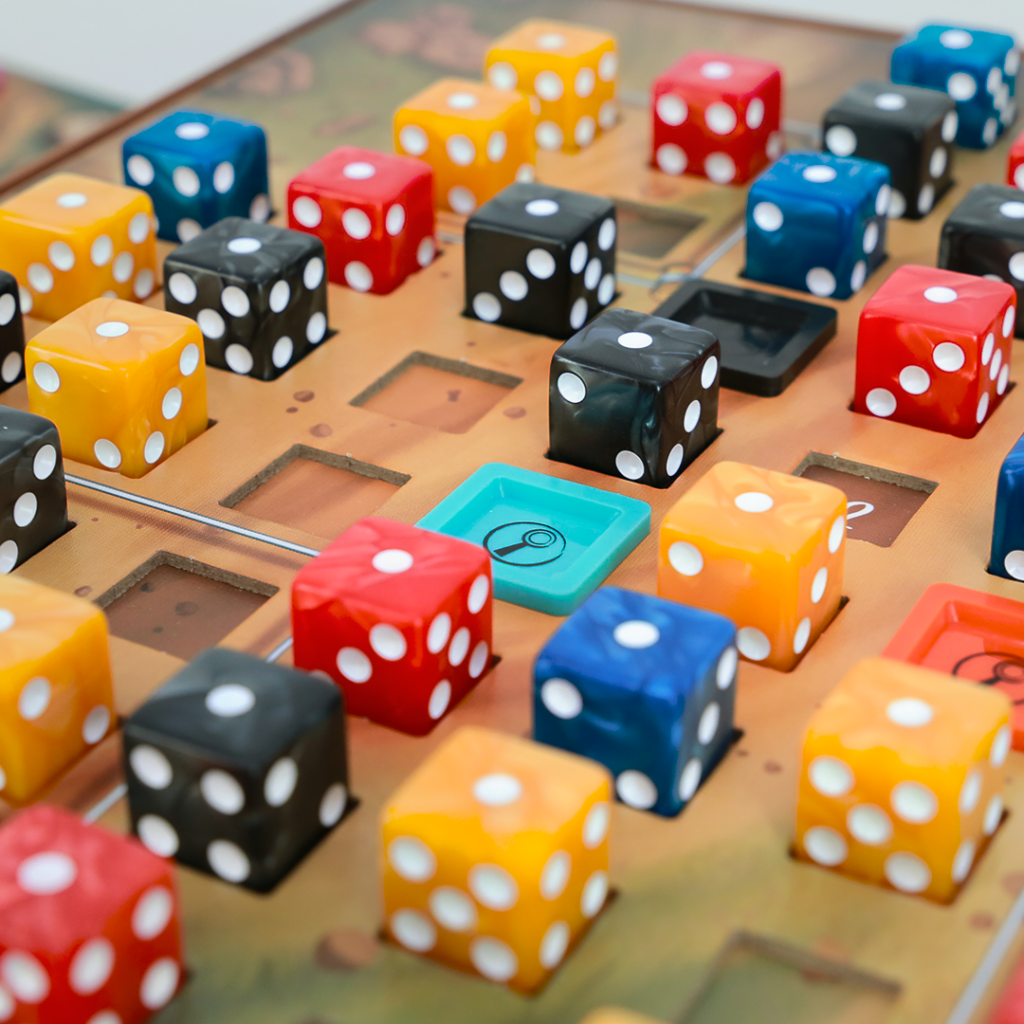
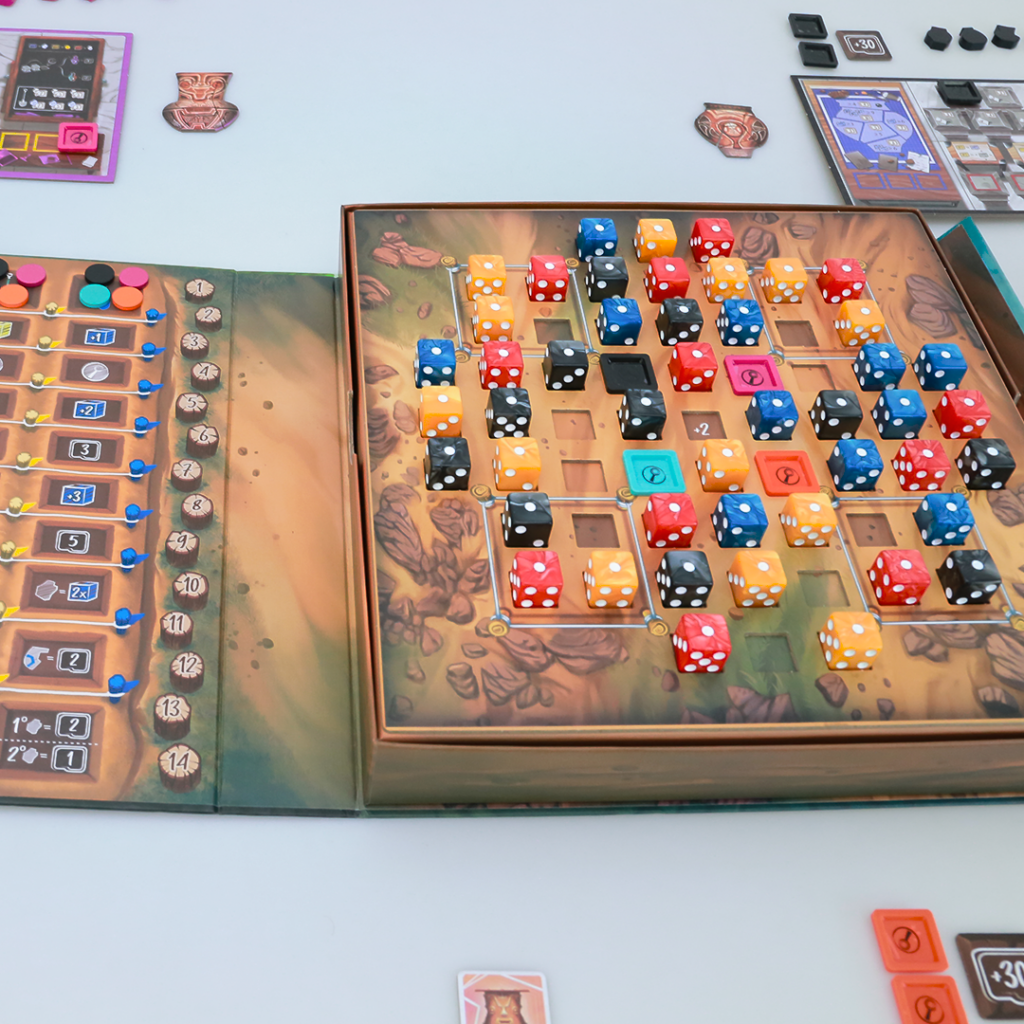
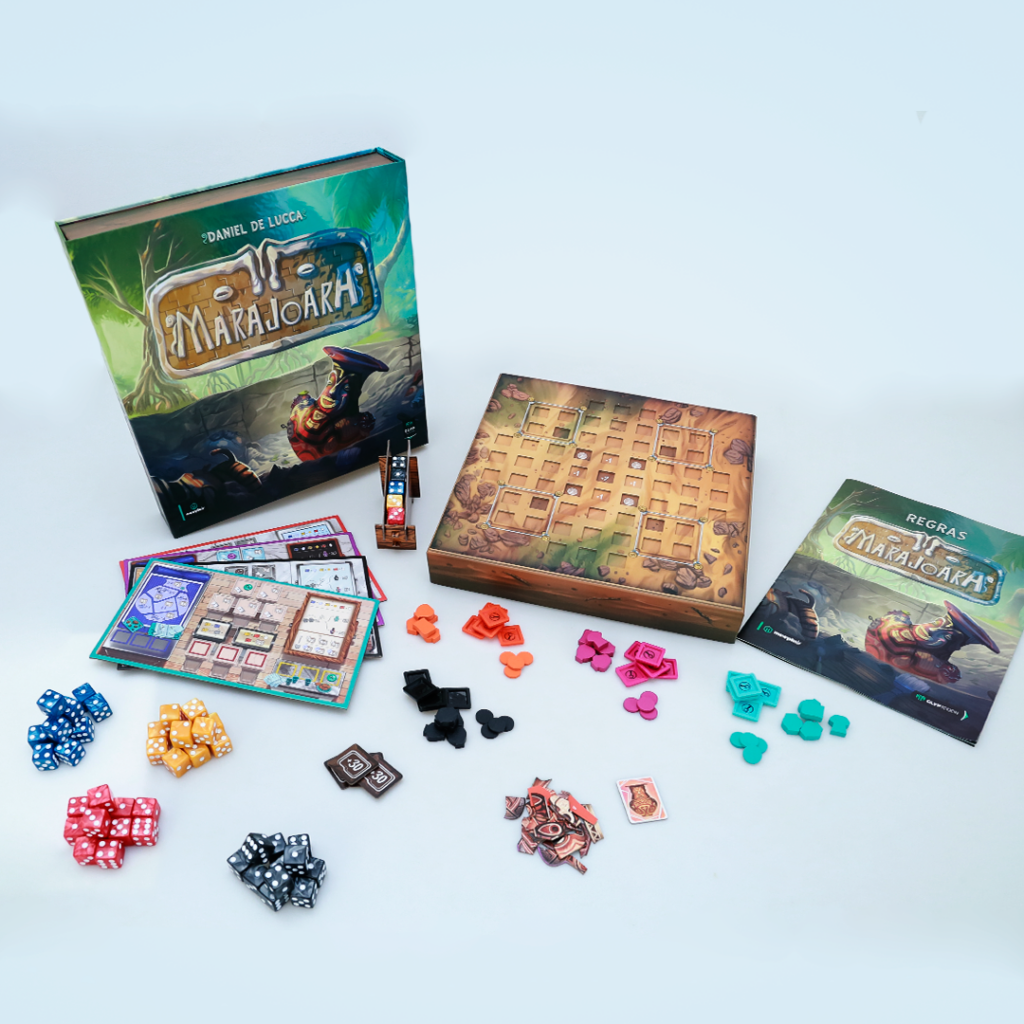
Final version of Marajoara.